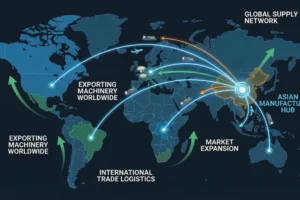

How Global Supply Chain Management Creates a Competitive Advantage for Modern Businesses
Every successful business depends on one thing that customers rarely see—the supply chain.
When a customer purchases a product, they usually notice the brand, packaging, quality, or price. Behind that purchase, however, is an extensive network of manufacturers, suppliers, warehouses, transport providers, customs authorities, and distribution partners working together to ensure the product reaches its destination on time.
A well-managed supply chain is no longer just an operational function. It has become a strategic business advantage.
Companies that manage their supply chains efficiently are able to reduce costs, respond quickly to market changes, maintain consistent product quality, and build stronger customer relationships. In contrast, businesses with weak supply chain processes often experience inventory shortages, production delays, rising operational expenses, and dissatisfied customers.
As global markets become increasingly interconnected, businesses need supply chains that are agile, resilient, and capable of supporting long-term growth. This is where Global Supply Chain Management becomes essential.
Whether you manufacture products, source internationally, operate under a private label, or distribute goods across multiple countries, an optimized supply chain provides the stability needed to compete successfully in today’s business environment.
What is Global Supply Chain Management?
Global Supply Chain Management is the process of planning, coordinating, and managing the movement of products, materials, information, and finances from suppliers to manufacturers and ultimately to customers across international markets.
It involves much more than transportation.
A modern supply chain includes:
- Supplier selection
- Procurement
- Manufacturing coordination
- Inventory management
- Quality assurance
- Packaging
- International logistics
- Customs documentation
- Warehousing
- Distribution
When these functions work together efficiently, businesses can improve productivity while delivering a better customer experience.
Why Supply Chain Management Matters More Than Ever
Today’s customers expect products to be available immediately. They also expect consistent quality and competitive pricing.
Meeting these expectations requires careful coordination across every stage of the supply chain.
An efficient supply chain helps businesses:
- Reduce operational costs
- Improve inventory accuracy
- Minimize production delays
- Increase customer satisfaction
- Respond quickly to market demand
- Support international expansion
Instead of reacting to supply chain disruptions, businesses with strong systems can anticipate challenges and adapt more effectively.
1. Better Supplier Relationships Create Better Business Results
The foundation of every supply chain is the supplier network.
Reliable suppliers do more than manufacture products—they become long-term business partners.
Strong supplier relationships lead to:
- Better communication
- Improved product quality
- Faster problem resolution
- Reliable delivery schedules
- Greater production flexibility
Businesses that invest in supplier partnerships often experience fewer operational disruptions and more consistent performance.
2. Improved Inventory Management
Too much inventory ties up working capital.
Too little inventory creates stock shortages and lost sales.
Effective supply chain management helps businesses maintain the right inventory levels by balancing customer demand with production capacity.
This results in:
- Reduced storage costs
- Better cash flow
- Improved warehouse efficiency
- Faster order fulfillment
Inventory optimization allows businesses to operate more efficiently without compromising product availability.
3. Reduced Business Risks
Every supply chain faces risks.
Unexpected events such as transportation delays, raw material shortages, geopolitical changes, or supplier issues can disrupt operations.
Businesses with diversified and well-managed supply chains are better prepared to handle these challenges.
Risk management strategies include:
- Working with verified suppliers
- Maintaining multiple sourcing options
- Monitoring supplier performance
- Implementing quality assurance processes
- Developing contingency plans
These proactive measures reduce uncertainty and improve business resilience.
4. Higher Product Quality
Quality begins long before a product reaches the customer.
It starts with selecting reliable suppliers, inspecting raw materials, monitoring production, and verifying finished products before shipment.
A strong supply chain integrates quality assurance at every stage.
The benefits include:
- Consistent product performance
- Fewer customer complaints
- Lower return rates
- Increased customer trust
Quality is one of the strongest differentiators in competitive markets.
5. Faster Delivery and Greater Customer Satisfaction
Delivery speed has become a major purchasing factor.
Customers expect businesses to fulfill orders quickly and accurately.
An optimized supply chain improves delivery performance through:
- Better production planning
- Efficient warehouse operations
- Reliable logistics partners
- Accurate inventory management
Meeting delivery commitments strengthens customer relationships and increases repeat business.
6. Supports Global Business Expansion
Expanding into international markets requires more than a good product.
Businesses must manage:
- International suppliers
- Export documentation
- Customs regulations
- Freight coordination
- Compliance requirements
A structured global supply chain simplifies these processes and enables businesses to expand into new markets with greater confidence.
Technology is Transforming Modern Supply Chains
Technology has changed the way businesses manage global operations.
Digital tools now provide real-time visibility across the supply chain, enabling faster and more informed decision-making.
Modern supply chain solutions include:
- Inventory management software
- ERP systems
- Real-time shipment tracking
- Digital procurement platforms
- Warehouse automation
- Data analytics
- AI-powered demand forecasting
These technologies improve operational efficiency while reducing manual errors.
Why Businesses Choose Fox Trail Global
At Fox Trail Global, we understand that a reliable supply chain is essential for sustainable business growth.
Our end-to-end sourcing and manufacturing solutions help businesses build efficient, resilient, and scalable supply chains.
Our services include:
- Global Sourcing
- OEM Manufacturing
- Private Label Manufacturing
- Supplier Verification
- Quality Assurance
- Export Documentation
- Packaging Solutions
- International Logistics Support
We work closely with trusted manufacturing partners and verified suppliers to ensure every stage of the supply chain meets the highest standards of quality, reliability, and efficiency.
Whether your business is sourcing products for domestic distribution or international export, we provide the expertise needed to simplify global operations.
Best Practices for Building a Strong Supply Chain
Businesses looking to strengthen their supply chains should focus on the following practices:
- Build long-term relationships with trusted suppliers.
- Verify supplier capabilities before production.
- Invest in quality assurance throughout manufacturing.
- Improve inventory planning using accurate demand forecasts.
- Adopt digital tools for better supply chain visibility.
- Regularly evaluate supplier performance and logistics efficiency.
- Diversify sourcing strategies to reduce dependency on a single supplier.
- Continuously review and improve operational processes.
These practices help businesses remain competitive in rapidly changing global markets.