Introduction
As businesses expand into new markets and product categories, one of the most important decisions they face is choosing the right manufacturing model. Two terms that frequently appear in the manufacturing and export industry are OEM Manufacturing and Private Label Manufacturing. While both models help businesses launch products without owning production facilities, they serve different strategic purposes.
Understanding the difference between OEM and Private Label Manufacturing can help importers, distributors, retailers, and entrepreneurs select the most effective approach for their business goals. Whether you are building a new brand, expanding your product portfolio, or entering international markets, choosing the right manufacturing partner is critical for long-term success.
What is OEM Manufacturing?
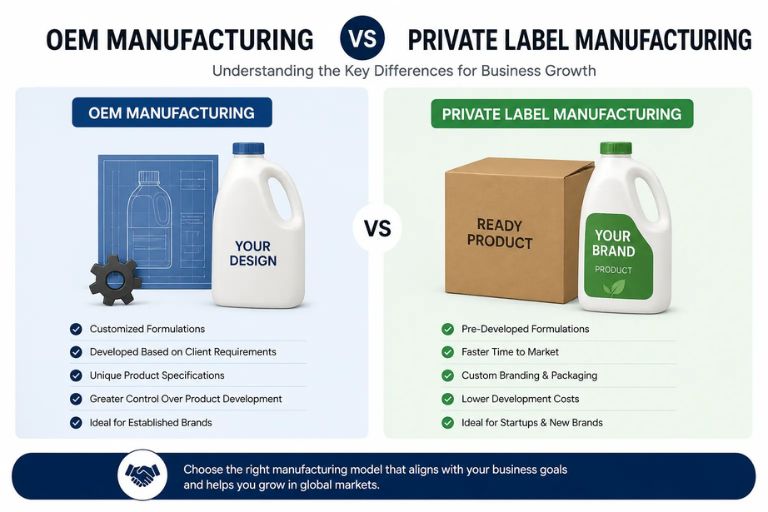
OEM stands for Original Equipment Manufacturer. In this model, a manufacturer produces products according to the buyer’s specific requirements, formulations, designs, or technical specifications.
The customer typically has greater control over product development and customization. OEM manufacturing is widely used across industries such as automotive care, industrial chemicals, personal care, home care, packaging, and consumer products.
For example, if a company wants a unique automotive shampoo formulation, custom packaging, and proprietary ingredients, an OEM manufacturer can develop and produce the product according to those exact requirements.
Key Characteristics of OEM Manufacturing
- Customized product formulations
- Product development based on client requirements
- Greater control over specifications
- Unique packaging and branding options
- Strong focus on innovation and differentiation
- Ideal for established brands seeking exclusivity
What is Private Label Manufacturing?
Private Label Manufacturing involves producing products that are sold under another company’s brand name. In most cases, the manufacturer already has proven formulations and production processes in place.
Businesses can select products from an existing portfolio and customize branding, labels, and packaging without investing in extensive product development.
Private label manufacturing is commonly used by retailers, distributors, e-commerce sellers, and startups looking to launch products quickly and cost-effectively.
Key Characteristics of Private Label Manufacturing
- Faster product launch
- Lower development costs
- Proven formulations
- Custom branding and packaging
- Reduced technical involvement
- Ideal for new and growing brands
Major Differences Between OEM and Private Label Manufacturing
Product Development
In OEM manufacturing, products are developed according to specific customer requirements. Businesses can create unique formulations, features, and specifications.
In private label manufacturing, products are generally selected from existing formulations and then customized through branding and packaging.
Time to Market
Private label manufacturing offers a faster route to market because products are already developed and production-ready.
OEM projects may require research, testing, formulation development, approvals, and multiple revisions before production begins.
Investment Requirements
OEM manufacturing typically requires higher investment due to product development, testing, and customization.
Private label manufacturing reduces upfront costs, making it attractive for startups and growing businesses.
Customization
OEM manufacturing provides maximum flexibility and product differentiation.
Private label manufacturing focuses more on branding and packaging customization while using established formulations.
Why Businesses Choose OEM Manufacturing
Many companies select OEM manufacturing when they want to build unique products that cannot be easily replicated by competitors.
OEM manufacturing is particularly beneficial for:
- Established brands
- Industrial product companies
- Automotive care manufacturers
- Specialized consumer products
- Premium product categories
- Businesses focused on innovation
OEM solutions help companies develop proprietary products that strengthen their competitive advantage in the marketplace.
Why Businesses Choose Private Label Manufacturing
Private label manufacturing has become increasingly popular due to its simplicity, affordability, and scalability.
Businesses often choose private label solutions because they offer:
- Faster launch timelines
- Lower risk
- Reduced development costs
- Easier inventory management
- Strong branding opportunities
- Access to proven manufacturing expertise
For many retailers and distributors, private label products generate higher profit margins while strengthening customer loyalty.
The Role of Quality and Compliance
Regardless of whether a business chooses OEM or Private Label Manufacturing, quality remains essential.
A reliable manufacturing partner should provide:
- Product Quality Assurance
- Manufacturing Excellence
- Batch Traceability
- Product Testing
- Export Documentation
- Regulatory Compliance
- Supply Chain Reliability
Quality-focused manufacturers help businesses maintain customer confidence while meeting international standards and market requirements.
How OEM and Private Label Support Global Expansion
Global demand for customized and branded products continues to increase across industries such as home care, automotive care, wellness, fragrances, food products, and consumer goods.
OEM and Private Label Manufacturing allow businesses to:
- Enter new international markets
- Expand product portfolios
- Improve profitability
- Strengthen brand identity
- Scale production efficiently
- Reduce operational complexity
With the right manufacturing partner, businesses can focus on sales, marketing, and market expansion while production and compliance are handled by experienced specialists.
Choosing the Right Manufacturing Partner
When evaluating manufacturing partners, businesses should consider:
Technical Capabilities
The manufacturer should possess strong product development, formulation, and production expertise.
Quality Systems
Look for comprehensive quality control and compliance processes.
Production Capacity
Manufacturing facilities should be capable of supporting future growth.
Export Experience
International trade knowledge helps simplify documentation, compliance, and logistics.
Long-Term Partnership Approach
A reliable manufacturer should act as a strategic partner rather than simply a supplier.
Conclusion
Both OEM Manufacturing and Private Label Manufacturing offer significant opportunities for businesses seeking growth, innovation, and market expansion.
OEM manufacturing is ideal for companies seeking unique, customized products and long-term product differentiation. Private label manufacturing provides a faster, lower-risk pathway for launching branded products and entering new markets.
The right choice depends on your business objectives, investment capacity, product strategy, and growth plans. By partnering with an experienced manufacturing and export specialist, businesses can build stronger brands, improve operational efficiency, and create sustainable growth opportunities in competitive global markets.